SSbD DAG · the evidence and the reference requirements
Layer 2 links the design-space representation to both the evidence generated within the project and the evidence requirements derived from the SSbD framework.
Project evidence
The evidence actually generated or reused within the project is associated with the relevant experiment nodes in L1. Evidence records can take any FAIR form — a published dataset (for example on Zenodo), a study in a domain data interface, or a structured export from an electronic lab notebook — as long as it is retrievable and citable from the graph.
One such implementation is the eNanoMapper/AMBIT study model, in which a measurement retains its experimental context — protocol, experimental parameters and conditions for the effect records (raw evidence). The data model is described in the FAIR data model for chemical substances chapter (Jeliazkova, Kochev and Tancheva, 2023); the underlying database infrastructure and its FAIR nanosafety data practices are described in Towards FAIR Nanosafety Data (Jeliazkova et al., 2021). This preserves individual observations and their provenance rather than reducing them to a single assessment value. Such studies can be exported as NeXus files (HDF5-based, already used in analytical science) and published at the domain data interfaces, where they can be searched and queried; the graph node links to them, so following an assessed_by link from a material reaches the measurement itself. An example is the HFX PHBV NeXus study at plastic.adma.ai.
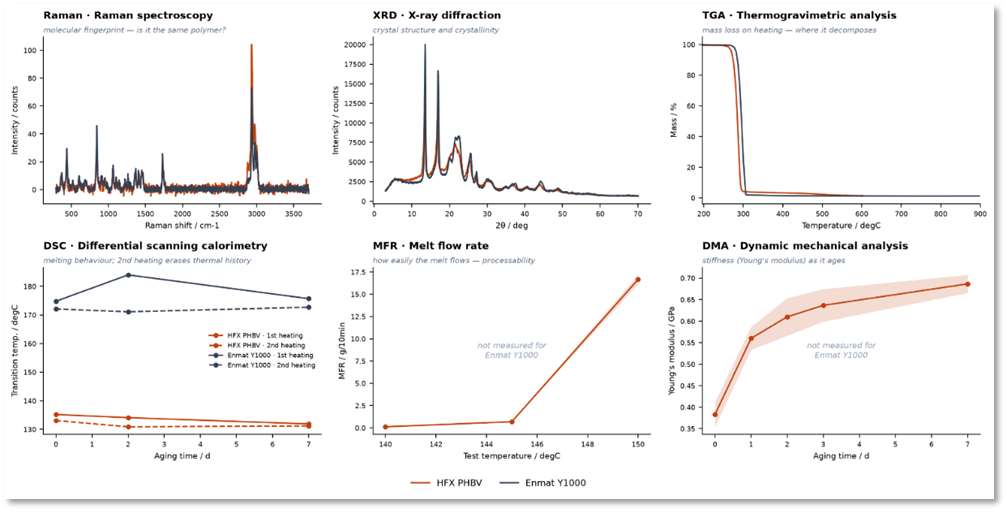
The design space recorded prospectively for the PHAntastic PHBV case: lemon processing residue and the production organism Haloferax mediterranei feed a culture-medium decision, then fermentation to HFX PHBV, followed by a nucleating-agent selection decision and micro-compounding. The experiment nodes link each resource to its evidence records — measurements, deposited datasets and published results — showing how the design-space record connects to the evidence in this layer.Analytical characterisation supporting comparative evidence on crystallisation behaviour and material performance of HFX-PHBV and the benchmark Enmat Y1000P. Seven techniques (NMR, Raman, XRD, TGA, DSC, MFR, DMA) each produce a different file format from a different instrument — all mapped to the same study model and linked to the SSbD design space as evidence.
SSbD evidence requirements
A catalogue of the evidence required to perform relevant SSbD assessments. Requirements are organised as dimension → aspect → indicator → method, together with acceptance or comparison criteria and other metadata associated with each indicator. Where available, acceptance criteria or reference values are derived from the corresponding assessment methodology or framework; the catalogue is completed with sector-specific and functionality requirements, and it is recorded as data alongside the DAG. Unlike the project graph, this layer contains reference information: it describes the evidence expected for an SSbD assessment, independently of whether a project has generated it.