Safe-and-Sustainable-by-Design design space as a directed acyclic graph
The SSbD framework (Commission Recommendation (EU) 2026/510) guides innovation towards safer and more sustainable chemicals and materials across their whole life cycles. The SSbD DAG approach models its design space as a directed acyclic graph of decisions and evidence: a project proceeds as a series of interdependent local comparisons at branching points, each anchored to FAIR data records.
The approach in brief
An evidence–decision representation
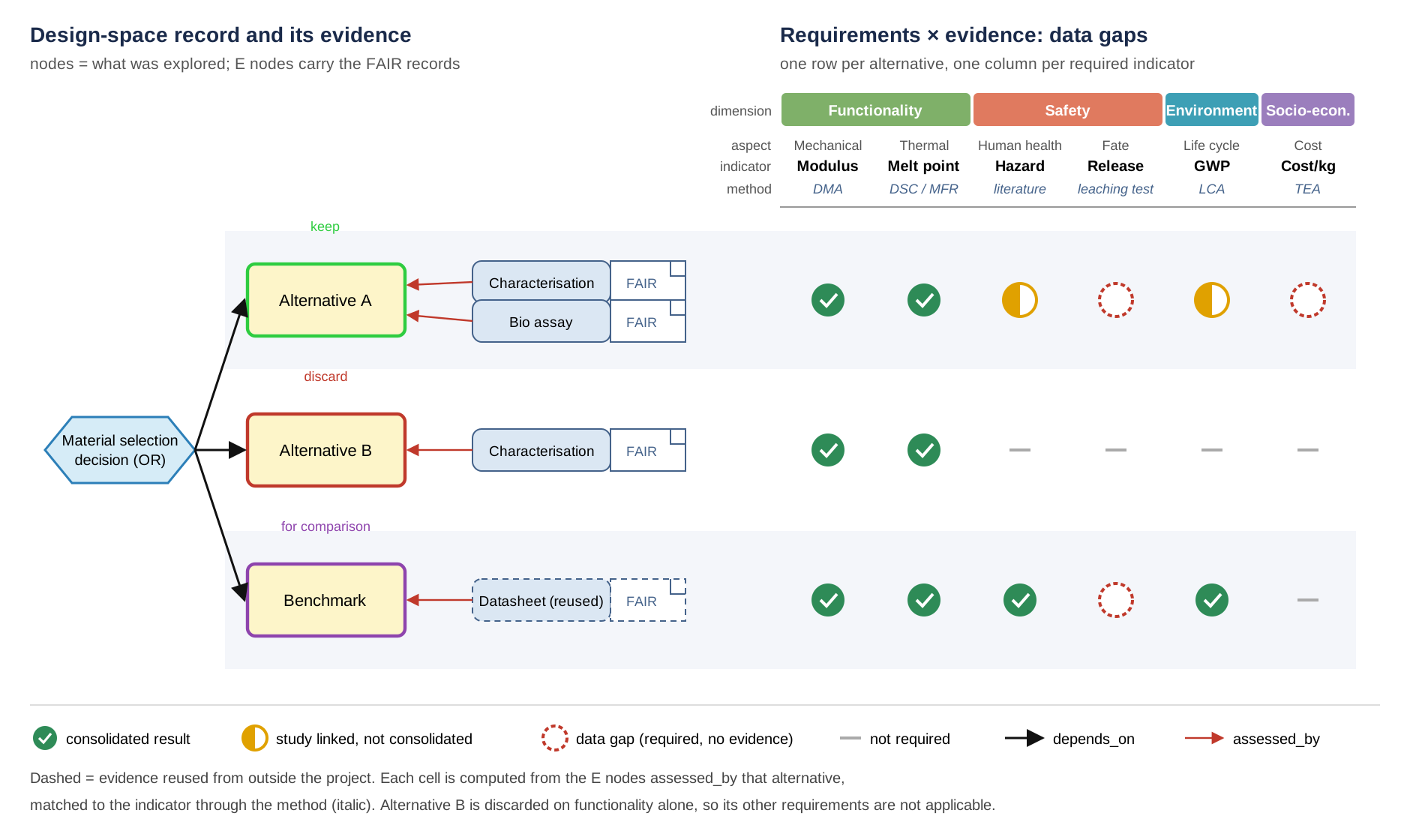
Research is experienced by the practitioner as an exploration of the design space: formulating hypotheses, generating or reusing evidence, interpreting results and comparing alternatives. The SSbD DAG provides the intermediate representation that connects reusable FAIR evidence with the evolving logic of SSbD innovation. Alternatives are resource nodes; experiment nodes link each alternative to its FAIR evidence records; and requirements (dimension → aspect → indicator → method) define which evidence is needed. Comparing the two gives the data gaps at each decision point — and repeating the comparison at every decision point gives the data gaps of the whole record.
Design-space record and data-gap matrix. Experiment nodes link each alternative to its FAIR evidence records; each cell of the matrix is derived from the evidence linked to that alternative — a consolidated result, a linked study not yet consolidated, a data gap, or not required.