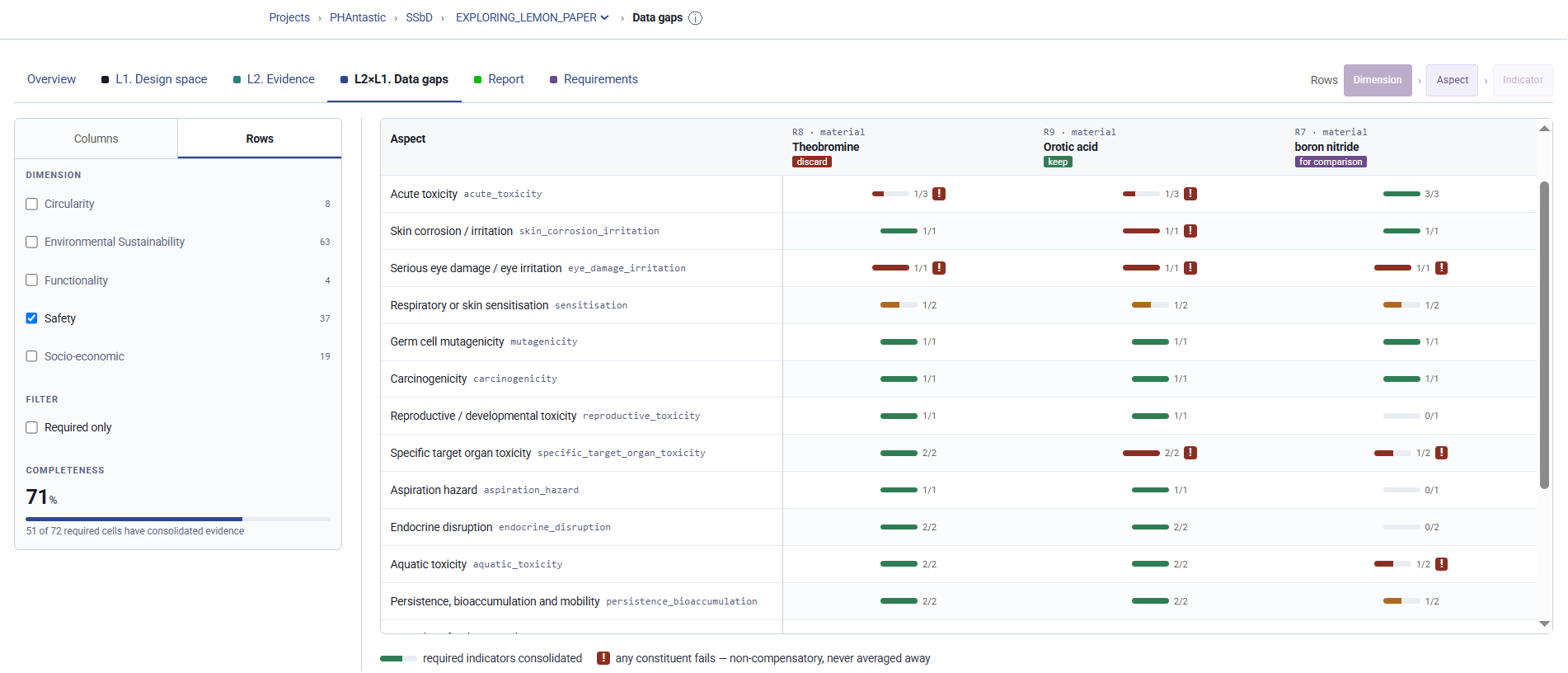
Layer 3 is computed from L1 and L2: for each node of the design space, the evidence linked to it is compared with the requirements catalogue, giving for each indicator one of: consolidated result, study linked but not consolidated, data gap, or not required.
Consolidation
A separate consolidation step transforms one or more measurements into an indicator-level result. The consolidated result records the evidence from which it was derived and carries a representation of uncertainty. An indicator may be a value with uncertainty (e.g. melting point) or a statement (e.g. the nucleating agent is present in the polymer). Because the consolidated result retains links to the evidence from which it was derived, the decision-level representation can be changed or recalculated without altering the underlying experimental record.
Coverage matrix (data gaps) for the nucleating-agent selection in the PHAntastic PHBV case: one row per alternative, one column per required indicator.
Data gaps analysis
Because required evidence (Layer 2) and available evidence (Layer 3) are represented independently, evidence coverage can be evaluated for any resource or design alternative. The system determines which applicable indicators have a valid consolidated result and which remain unsupported, partially supported or unresolved. Importantly, the mere presence of a linked study does not imply that an indicator requirement has been satisfied; satisfaction is evaluated only after the relevant evidence has been consolidated against the applicable requirement. The resulting gap analysis can support prioritisation of additional measurements or assessments, using decision rules, MCDA or expert judgement depending on the decision context.
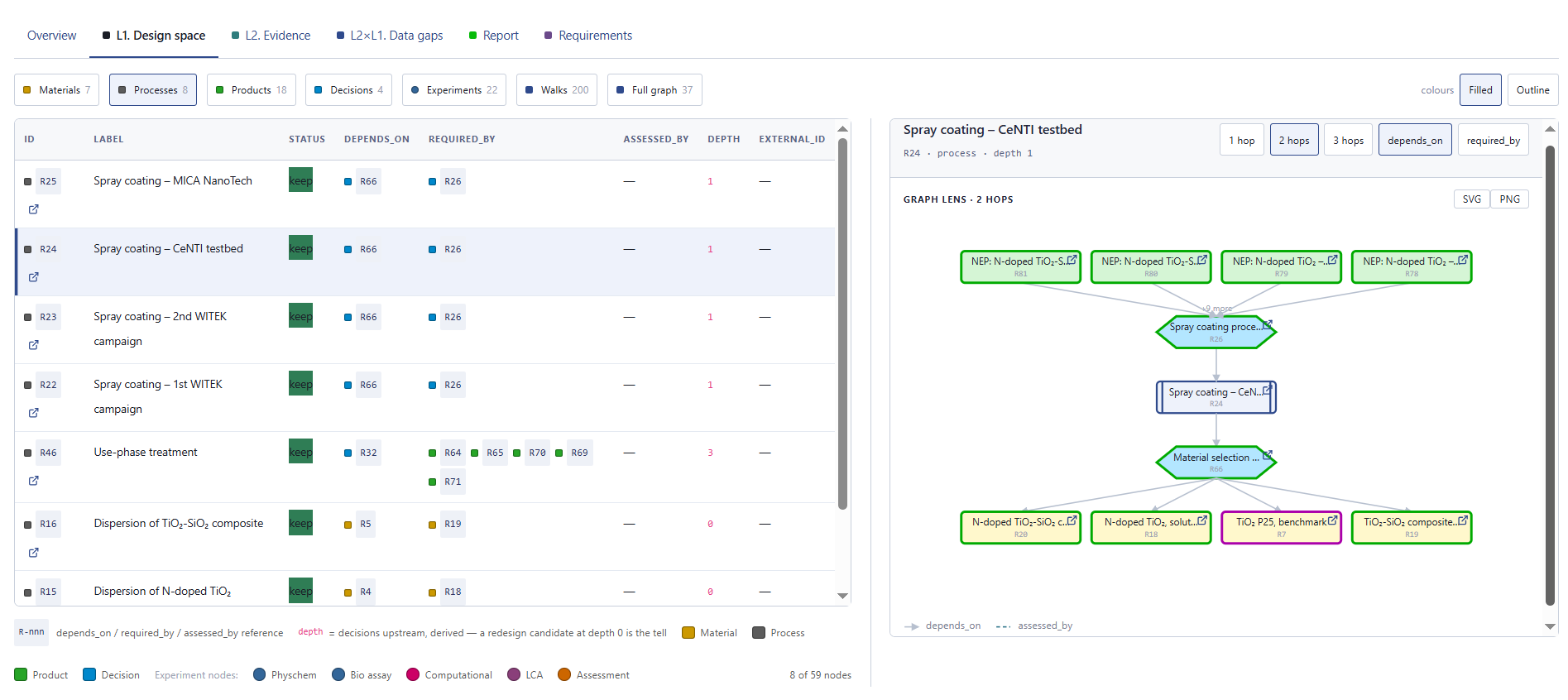
The ASINA design space in the SSbD Navigator — the Layer 1 record of the explored design space, whose evidence links feed the coverage and data-gap analysis of this layer. ASINA developed a data-driven safe-and-sustainable methodology for TiO2-based photocatalytic depolluting surfaces, described in Furxhi et al., 2024.